What is the difference between active RFID and passive for enterprise asset tracking in the real world? Discover how automated methods stack up against manual efforts.
These are the types of returns our customers realize and that could be possible for you.
Trusted by Leading Active RFID Enterprises
 Equinix
  Dell
Dell  HPE
HPE  IBM
IBM  Vodafone
  Microsoft
  Oracle
  AT&T
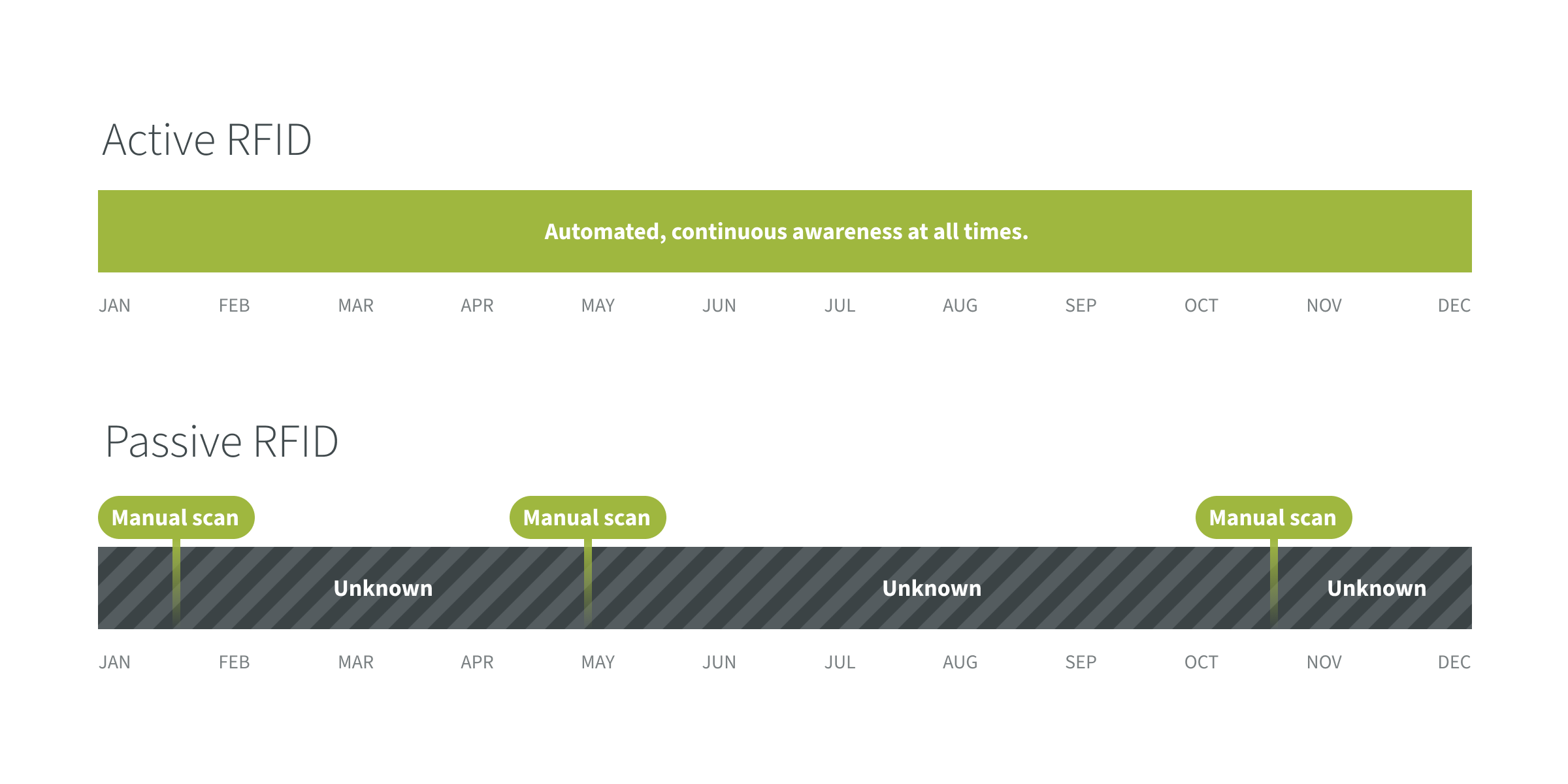
AT&T Active and passive RFID operate in fundamentally different ways. One is a continuous, automated telemetry system; the other is a hand-held digital barcode reader.
An active RFID asset tag actively sends a beacon signal. It utilizes an internal power source (battery) to operate continuously and dynamically—broadcasting location telemetry without human intervention.
By contrast, a passive tag is completely inactive and dormant. It has no battery. To read a passive tag, a staff member must physically walk up to it with an energized handheld reader, which blasts electromagnetic energy to wake and read the tag. If a human isn't scanning, the tag does not exist.
Quick comparison of technical features across Active, Passive, and Barcode technologies.
| Feature Matrix | Active RFID (RF Code) | Passive RFID | Barcodes / QR |
|---|---|---|---|
| Actively sends a signal | Yes
| No
| No
|
| Internal power source | Yes
| No
| No
|
| Operates automatically | Yes
| No
| No
|
| Age of location data | +/- 2 minutes | Last manual scan | Last manual scan |
| Asset tag read volume | 1,400 per reader, simultaneously | One asset tag at a time per person | One asset tag at a time per person |
| Asset tag read frequency | Continuous, automatic | One time, manual | One time, manual |
| Read distance | Up to 300 feet (91m) | Close to the tag (3 – 12 inches) | Close to the tag (3 – 12 inches) |
Active RFID for data center asset management can eliminate manual effort, whereas passive RFID can only augment manual effort.
Active RFID asset tags can replace manual audit effort entirely. Audits happen continuously and automatically. With active RFID, the detected location is compared against the asset’s recorded location and mismatches are reported in real time. Customers save massive amounts of time and money by letting sensors do the auditing.
Passive RFID asset tags support manual audit effort, but do not replace it. Even with passive tags, you must send a team with hand-held scanners to find and scan assets inside your data centers. While slightly more efficient than spreadsheets, it remains heavily dependent on manual human schedules.
Active RFID tags provide real-time inventory reporting and reduce the cost of idle assets. The system continuously detects all assets in all locations by rack, room, and zone, including offline/unpowered assets. You know exactly where each asset is now, preventing hundreds of wasted hours searching loading docks or server cages.
Passive RFID tags provide a snapshot of the last time assets were scanned, but fail to report the current state in real time. For locating assets in storage or misplaced assets, you only know where they were the last time someone manually scanned them—not where they are located at this moment.
Active RFID asset tracking solutions replace manual effort completely. Instead of data center teams spending hours maintaining records or searching server racks, they can look up an asset’s location in real time and go straight to it. Audits and reconciliation run continuously behind the scenes, freeing engineers to focus on critical tasks.
Passive RFID asset tracking solutions reduce record-keeping effort slightly, but still require significant manual processes. Reading a passive RFID tag is more convenient than typing on a laptop, but behaves similarly to barcodes or QR codes. Teams must still physically traverse the facility to capture data.
Active RFID solutions maintain an automated chain of custody for high compliance and minimal loss. Time, date, and location are permanently logged from delivery to decommission. Active tags are widely deployed on hard drives awaiting disposal to prevent critical data exposure, avoiding millions in regulatory fines.
Passive RFID solutions struggle to meaningfully impact compliance and loss because they lack proactive alerts. They cannot notify you when an asset walks out of a room or is incorrectly racked. You are left wondering where a missing server went until the next manual sweep is scheduled weeks or months later.
Active RFID solutions provide a significantly higher cumulative return on investment. While active tags have a higher unit price, the elimination of manual audit labor, the reduction of capital at rest through inventory optimization, and the prevention of data breaches produce a rapid and compound ROI.
Passive RFID tags have a lower tag price, but deliver a significantly lower return. Because they only augment manual effort without eliminating it, they rarely outperform standard barcode systems. They still demand expensive labor hours, failing to produce meaningful operational cost reductions.
Visualizing how active sensors automate audits and asset status mapping dynamically.
Learn from industry leaders who have audited, evaluated, and deployed RFID solutions under real-world data center workloads.
Shares experience on how healthcare facilities reduce costly IT asset blind spots and automate security compliance.
Explores active vs. passive RFID parameters, detailing which engineering paradigm matches server room workloads.
Let us show you how active RFID telemetry can eliminate manual inventory audits, automate compliance, and boost operational efficiency.
